✦ Start here: the quick read
If you've read what astrocartography is and how the system works, you already know the basics: your natal chart projected onto the surface of the Earth, around 40 lines, each one a planet meeting a chart angle. You know the theory.
This article is the practical part. You have your chart open, or you're about to pull one up, and you want to know what you're actually looking at. Where to start. What to pay attention to. What to ignore for now. And what the lines actually mean when they cross a place you care about.
By the end, you'll be able to look at your own astrocartography chart and read it with real understanding, not just curiosity.
How to pull up your free astrocartography chart
You need three things: your birth date, your birth time, and your birth location. All three matter. The birth time especially, because the four chart angles (Midheaven, IC, Ascendant, Descendant) shift dramatically based on time of day. If your birth time is off by just 15 minutes, your line positions can shift by hundreds of kilometers.
The two tools I'd point anyone to are AstroSeek and AstroDienst. Both are free, both are reputable, and both run on the Swiss Ephemeris, the standard chart-calculation engine in contemporary astrology. The positions you see on a free tool are the same ones I work from in a professional reading.
Here's what to do:
- Go to AstroSeek's astrocartography page (or AstroDienst's equivalent).
- Enter your birth date, time, and city.
- Generate the map.
What loads is your astrocartography chart: a world map with colored lines sweeping across continents and oceans. It can look overwhelming at first, and that's completely normal. You're looking at around 40 lines, and they're all labeled, and nothing about it is immediately intuitive.
But right now, a first look is exactly what you need. Don't try to take in all 40 lines at once. That's the first and most important rule of reading your chart.
Understanding your astrocartography map
Your astrocartography chart is a flat projection of the globe with your personal planetary lines drawn across it. Each line represents a specific planet at a specific chart angle, and each line has a label telling you which planet and which angle it is.
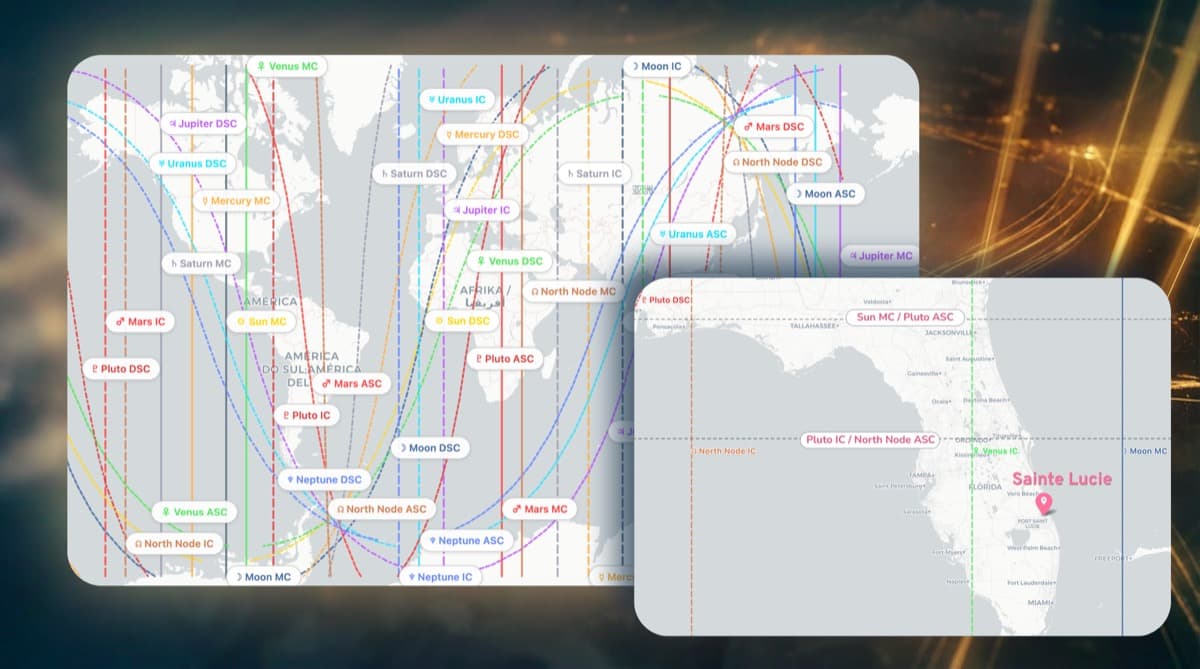
The colored lines are your planetary lines. Each color represents a different planet. Some lines run nearly straight up and down (the MC and IC lines), while others curve across the map (the ASC and DSC lines). The color tells you which planet. The shape of the line tells you which angle.
If you're using a free chart, all lines show at once. On an interactive map, you can toggle each planet individually, which makes the chart dramatically easier to read. For now, focus on the region you care about and let the rest blur.
The labels on each line tell you both pieces at once: "Venus MC" means Venus on the Midheaven. "Saturn IC" means Saturn on the Imum Coeli. Once you learn the pattern, you can read any label on the map.
Where to focus first: zoom into the region where you currently live, or a region you're seriously considering. Ignore the rest of the map for now. The lines that matter most are the ones near places that matter to you.
The 10 astrocartography lines: what each planet tends to bring
Every planet on your chart carries its own symbolic register. When a planetary line passes near a place, those themes tend to become more present in your experience there.
The personal planets
Identity, vitality, purpose. Sun lines mark places where you tend to become more visible and more sharply defined. Career visibility, public recognition, and a clearer sense of direction tend to come into focus. The challenging side: that same spotlight can become exhausting. Ego can inflate.
Emotion, intuition, belonging. Moon lines mark places where your inner world becomes more prominent. Comfort, nurturing, and the question "where do I belong?" tend to get louder. Moon IC is widely considered one of the most powerful single placements in astrocartography. This is the "home" line.
Communication, learning, connection. Mercury lines mark places where thinking sharpens, conversation flows more easily, and intellectual curiosity increases. You might find yourself drawn to writing, teaching, or media. The challenging side: mental restlessness and scattered focus.
Love, beauty, harmony, ease. Venus lines mark places where life tends to soften and warm. Social connections flow more easily. Aesthetics, sensory pleasure, and romantic energy tend to become more present. Venus lines are among the most sought-after in astrocartography. The challenging side: grace can slide into indulgence or complacency.
Drive, energy, action, assertion. Mars lines mark places where your motivation sharpens and your physical energy rises. Courage increases. You tend to take on challenges you'd normally avoid. The challenging side: increased irritability, impulsiveness, and conflict. The practitioner principle for Mars: "use Mars before Mars uses you."
The outer planets
Expansion, opportunity, optimism, growth. Jupiter lines mark places where doors tend to open more easily. Often called the "lucky" planet, and Jupiter lines are among the most consistently favorable in reported experience. Education, travel, financial flow, and philosophical growth tend to flourish. The challenging side: Jupiter expands everything, including excess. Overconfidence, overspending, weight gain, and taking on too much.
Structure, discipline, authority, testing. Saturn lines mark places where things get serious. Heavy foundations, career authority, and earning credibility through persistence. Saturn doesn't make places easy. It makes them real. People who thrive on Saturn lines tend to be building something that lasts. The challenging side: restriction, loneliness, a sense that everything requires more effort, and ancestral or family patterns coming to the surface.
Freedom, disruption, originality. Uranus lines mark places where the unconventional becomes more accessible. Sudden changes, electric identity, standing out from the crowd. If you're drawn to reinvention, a career pivot, or a fundamentally different way of living, Uranus lines can catalyze that. The challenging side: instability, sudden reversals, difficulty settling into routine, and a restlessness that can make long-term planning feel impossible.
Spirituality, imagination, illusion. Neptune lines mark places where the boundary between inner and outer worlds gets thinner. Artistic inspiration, spiritual depth, and dreamlike experiences tend to increase. If you're a creative, a healer, or someone drawn to contemplative practices, Neptune lines can feel deeply nourishing. The challenging side: confusion, boundary-less sensitivity, difficulty seeing situations clearly, and a tendency to idealize places or people.
Transformation, power, depth. Pluto lines mark places where the deepest changes tend to happen. Career transformation, rebuilding foundations from the ground up, confronting what you've been avoiding. Pluto doesn't do surface-level. People often describe Pluto-line experiences as the most intense and the most meaningful of their lives. The challenging side: power struggles, emotional intensity, and the feeling that everything is being torn down to be rebuilt.
Growth direction, unfamiliar territory. The North Node isn't a planet but a calculated point that represents your growth edge. North Node lines mark places that tend to push you beyond your comfort zone in ways that feel expansive rather than threatening. Career directions you wouldn't have considered, foundations in unfamiliar territory, relationships that challenge your patterns.
How they change what each line means
The same planet shows up differently depending on which angle the line represents. Venus on the Midheaven is a very different experience than Venus on the IC. The planet is the what. The angle is the where in your life it tends to express.
If you've read what astrocartography is, you've already met the four angles. Here's a quick reference:
MC (Midheaven): your public life. Career, reputation, visibility. A planet on an MC line tends to amplify its themes in your professional and outward-facing life.
IC (Imum Coeli): your inner life. Home, family, emotional foundations. A planet on an IC line tends to shape your private world and your sense of belonging.
ASC (Ascendant): your identity. First impressions, self-expression, how others perceive you. A planet on an ASC line tends to color your personality and visible energy in that place.
DSC (Descendant): your relationships. Partnerships, collaborations, who you attract. A planet on a DSC line tends to shape the relational dynamics you encounter.
On a visual chart, you can identify which angle a line represents by its shape and dash pattern. MC and IC lines run nearly straight up and down (vertical). ASC and DSC lines curve across the map. Each angle type also uses a different dash pattern: solid for MC, dashed for IC, dotted for ASC, and dash-dot for DSC. Match the color to identify the planet, then check the dash pattern to identify the angle.
So when you see "Venus MC" on your chart, it means: Venus themes (ease, beauty, connection) tend to express most strongly in your career and public life at that location. "Venus IC" means those same themes tend to express in your home life and emotional world there. Same planet, different angle, different felt experience.
Finding your strongest lines
Not all lines on your chart carry equal weight. Some are close to places that matter to you. Others cross oceans or cities you'll never visit. The practical skill is learning which lines to pay attention to first.
Start with geography: places you care about
Zoom into the places that are real for you. The city you live in now. The city you're considering for a move. The place you visited once and felt something you couldn't explain. Look at which lines pass within a few hundred kilometers of those places.
If three or four lines pass near a single city, that's a meaningful signal. If only one line passes nearby, it's worth reading but it's a single data point, not a pattern.
Reading orb and distance
The technical word for "how close" a line is to a place is orb. It's measured in kilometers. The closer the orb, the stronger the line's influence tends to be.
Most practitioners pay attention to lines within roughly 700 kilometers of a city, though some go tighter and some go wider. A line running directly through a city (orb near zero) is a strong signal. A line at 500 kilometers is meaningful. A line at 1,200 kilometers is softer but not silent.
Clusters and intersections
The strongest signals on any astrocartography chart aren't usually single lines. They're places where two or three lines converge near the same location. A Venus line and a Jupiter line both passing within 300 kilometers of a city creates a layered influence that's more significant than either line alone.
I read for a client recently who had a Venus-Jupiter-Moon cluster near a mid-sized coastal city she'd visited once. Three planets, all within 400 kilometers. When we talked through what those three themes would feel like layered together (ease, expansion, and belonging), she said it matched exactly how she'd felt the weekend she was there. That cluster told a story no single line could.
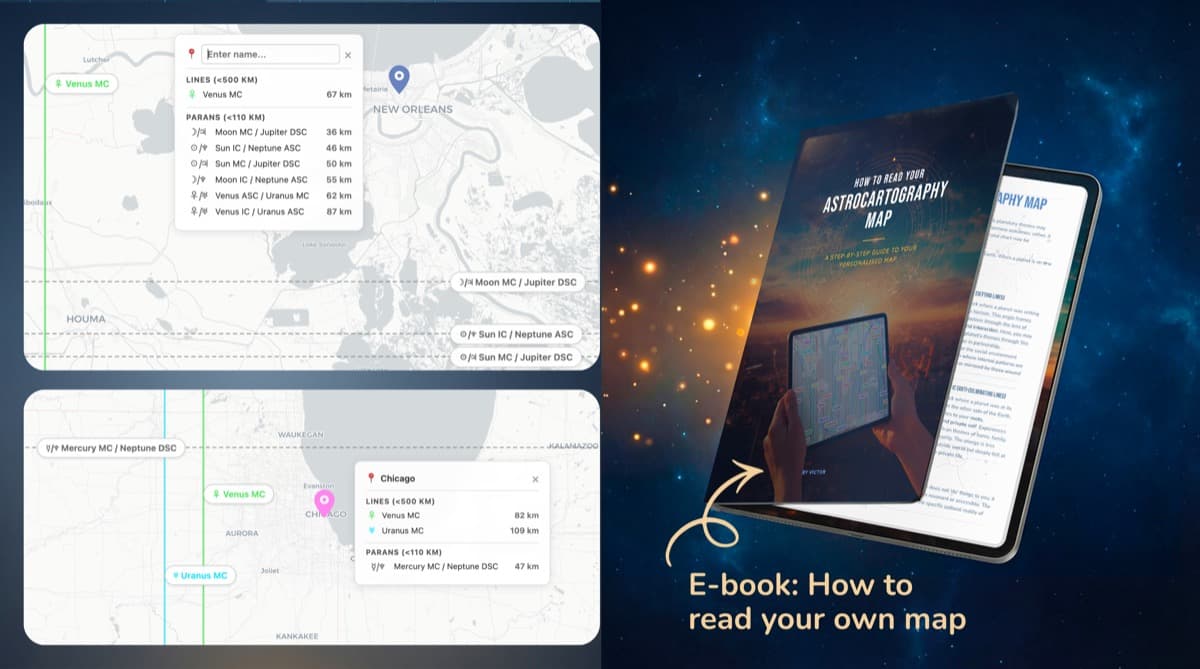
One more thing worth knowing: there's a deeper layer called paran lines that reveals hidden influence zones where two planets are angular at the same latitude. Free charts don't show parans. They're a layer you'll only see on a professional-grade interactive map. If you're working from AstroSeek right now, you're reading the main planetary lines only, which is a strong starting point. Parans are the next level of depth.

What to do with what you find
Once you've identified your strongest lines and the places they cross, here's a practical reading sequence:
Journal what you notice. Write down the 3-5 lines closest to places you care about. Note the planet, the angle, and the orb distance. Then read the planet descriptions above and the angle framework. What themes would be amplified in that place? Does that match your experience, if you've been there? Does it match what you're looking for, if you haven't?
Compare 2-3 cities. If you're weighing specific places for a move or a trip, pull up the lines near each one. Which city has the most supportive cluster? Which has a challenging line you'd need to work with consciously? Astrocartography doesn't pick winners for you, but it gives you a framework for comparing what each place is likely to bring up. If you'd rather have a practitioner compare specific cities for you, that's what our personalized readings are built for.
Know the difference between a first look and real exploration. This article gave you the overview. If you pulled up a free chart while reading, you've had your first real look at your lines. That's the foundation.
If you want to go deeper, our Interactive Map Explorer is the next step. It builds a fully interactive map from your exact birth data. You can zoom into any city, toggle each planet on and off individually, explore paran lines (which free tools don't show), and click any city to see exactly which lines pass nearby and at what distance. The Standard tier includes a 68-page e-book guide that walks you through every line on your map, step by step, in far more depth than any article can.
The free chart is your first look. The interactive map is where the real exploration happens.
With care, Victor