

✦ Start here: the quick read
If you just pulled up your astrocartography chart and saw a Pluto line near a place you've been thinking about, the internet probably told you it's the dangerous line. The death line. The line to avoid. I want to give you something more honest than that.
The Pluto line is the place on your map where themes of excavation, transformation, and rebuilding tend to show up more actively. It's not destruction. It's not fate. It's more like a pressure that surfaces what's been buried: the chapter that's been ending, the version of yourself you've outgrown, the structure that's been hollow for longer than you wanted to admit.
If you're new to the system, what astrocartography is and how it works is the foundation, and how to read your astrocartography chart walks you through all 40 lines.
This one's just about Pluto. What it tends to bring up at each angle, what the shadow side actually looks like, and the chapters where a Pluto line is the right move.
What Pluto represents on your map
Pluto is the part of your chart wired for depth, power, and what most astrologers call death-and-rebirth (which sounds dramatic until you realize it just means "endings that make room for what's next"). Where your Pluto line crosses the Earth, those themes tend to wake up more actively. The place itself often has a quality of pressure: things tend to get real there, faster than they do elsewhere.
Between Victor and me, we've completed 500+ readings, and here's the pattern I keep seeing: people on their Pluto lines often describe a chapter where something they'd been holding together quietly came apart, and the version that rebuilt afterward fit better than the one before. A career they'd outgrown finally ended. A relationship that had been hollow for years finally named itself. A version of themselves they'd been performing finally fell away. The line doesn't cause the ending. It tends to finish what was already ending.
That's what makes it different from the Saturn line, which tends to ask for structure and discipline, and from the Jupiter line, which tends to expand. Pluto restructures. Most lives go through a Pluto chapter at some point, with or without the geography.
How Pluto shows up differently
Same planet, different domains of life. Here's what shows up most in readings, with the real-life translation for each.


Your career restructures
Here's what I see most in readings on Pluto MC lines: the professional life rearranges itself around a version of you that's actually you, not the one you'd been performing. The job that ends because it has to. The pivot that's been coming for two years and finally arrives. The role that asks more honesty of you than the last one did.
This might look like a chapter where you finally stop performing the version of yourself you'd outgrown years ago, and the work rearranges around the version that's underneath. The role that was draining you ends. The next one is harder to name and more yours.
The shadow tends to be power-and-ambition tangles. Pluto MC can turn ambition into power-struggle, intensity into purpose-substitute. You can mistake "this is hard and consuming" for "this is meaningful," and end up several years into a chapter that was about proving something rather than building something.

Home and roots rebuild from underneath
This is the deepest angle for Pluto, and the one a lot of people don't see coming. The Pluto IC tends to rebuild your private life from the foundation up. Family patterns surface and get reckoned with. Inherited dynamics that ran the household quietly finally name themselves. The home you create here tends to be the home you build on different terms than the one you came from.
This might look like a chapter where the foundation gets redone underneath you. Family stories you'd accepted at face value finally crack open. The home you create looks less like the one you were raised in and more like one you actually chose.
The shadow is real here. Pluto IC can turn the private rebuild into a loop: tearing things down, half-rebuilding, tearing them down again. It can also surface family material faster than you have the support to hold. Honestly, if I could pick one line for someone in a chapter ready for an honest reckoning with their lineage, Pluto IC is high on the list. If I were picking a line for someone who needs a stable home base while they recover from something else, I'd point them somewhere else.

How you're perceived shifts irreversibly
Pluto on the Ascendant tends to shift how you carry yourself in a way other people register before you do. Clients on Pluto ASC lines often tell me that people who hadn't seen them in a year don't quite recognize them. Not in a bad way. They just look like a different version of themselves, and the old version isn't coming back.
This might look like coming out of a chapter looking different. The version of yourself you'd been performing finally falls away. People you've known for years either adjust or fall out of the picture. New people meet the version that's actually you, and the response to that version is different.
Personal side note: I've watched clients on Pluto ASC lines reinvent themselves so completely that the reinvention started to look like avoidance. The line can give you permission to leave a version of yourself behind. It can also let you skip the part where you understand what you're leaving and why.

Relationships restructure to the bone
The internet doesn't have a tidy nickname for Pluto DSC (sometimes called the Pluto DC line) the way it does for Venus or Jupiter, and I'm honestly relieved. Pluto on the Descendant tends to bring partnerships that restructure you. Not all of them romantic. The friend who refuses to look away from what you've buried. The collaborator who reflects you back to yourself in a way nobody else has. The partner who can hold what you've been carrying alone.
This might look like the relationship that ends an old version of you, and the next one starts on different terms. Or the existing relationship that finally has the conversation it's been deferring for five years.
Here's my honest take: Pluto DSC isn't romantic in the soft way Venus DSC is. It's intimate in a way that asks something of you. The connections you form here tend to leave a mark, and the mark isn't always pretty in the moment. Whether it ends up generative depends on whether you're both willing to stay honest. The line can't tell you that. The relationship has to.
The shadow side (because Pluto has one)
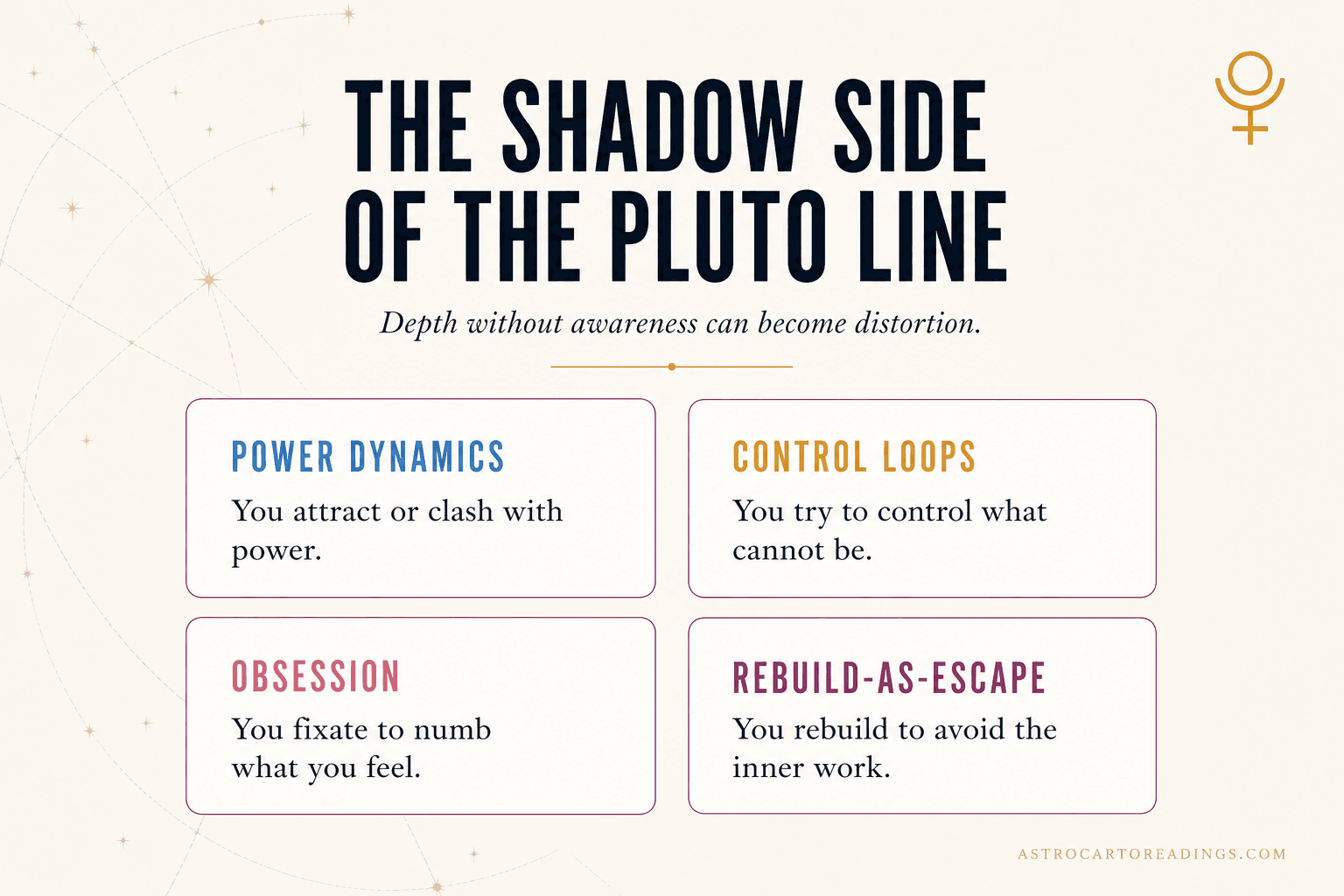
Let me be honest about this part, because the "dangerous line" framing flattens it into something scary, and the "Pluto is misunderstood and beautiful" framing skips it entirely. Both miss what's actually there.
The shadow of Pluto isn't punishment. It's transformation without integration. Power dynamics that surface and don't get worked through. The control-and-release loop, where you hold everything together until you can't, blow it up, rebuild, and start holding again. Obsession with a person, a project, or a version of the future that won't let you put it down. The rebuild-as-escape trap, where what looks like transformation is actually flight.
I've read for clients who came out of Pluto chapters more themselves than they'd ever been, and for clients who kept blowing their lives up and calling it growth. The difference usually wasn't the line. It was whether the chapter actually wanted excavation, and whether the person had support around them to hold what surfaced. That's why the chapter-matching question matters so much when you're choosing where to live.
Pluto asks a real question: are you ready to let something end? If yes, the line tends to make space. If you arrive trying to hold on tighter, it tends to surface that, too.
How to find your Pluto line
Here's the quick version, because this part can feel intimidating the first time. Go to AstroSeek or Astro.com, enter your birth data, and pull up your astrocartography map. Look for the lines labeled with the Pluto symbol (♇). You'll see up to four Pluto lines crossing the globe, one for each angle. Most people only have one or two Pluto lines running through regions they'd realistically consider, and that's normal.
Pay attention to orb. The influence tends to be strongest right at the line and fades within about 4-5 degrees of longitude. A city 2 degrees from your Pluto IC will likely feel the effect more strongly than one 5 degrees away. Close enough is close enough.
If you want a quick reference for all the planet-line combinations while you explore, our free astrocartography cheatsheet covers every one, including all four Pluto angles.
If you find a Pluto line near a place you've already lived or visited, ask yourself this: did the experience there feel like a chapter where something ended, restructured, or came apart so something else could form? Pluto tends to leave that kind of mark, and your own memory is the most honest validation the system offers.
When the Pluto line is actually the right line
Most online Pluto content skips this part, and it's the part that matters most.
A Pluto line tends to be the right line when you're in a chapter that actually wants excavation: an ending you've been deferring, a version of yourself you've outgrown, a structure in your life that's been hollow for longer than you've admitted. If you're in a chapter that wants stability, recovery, or quiet, a Venus or Jupiter line tends to serve better. None of this is permanent. A city that wasn't right at 32 might be exactly right at 38.
If you're weighing a Pluto line against other cities and want to see how it actually compares for your chart in your chapter, that's what our Compare Cities reading is built for. I look at the full picture, not just one line, so you can see whether the Pluto city is the right kind of intensity for the chapter you're actually in.
Here's what I want you to take away: the Pluto line isn't the dangerous line. It's the line that tends to surface what's already buried and finish what's already ending. Match the line to the chapter, and Pluto can be the most generative geography on your map.
With warmth, Jules