

✦ Start here: the quick read
If you've Googled "best astrocartography lines," you've probably landed on a listicle that ranks Venus and Jupiter at the top and Saturn and Pluto at the bottom. Here's the more honest version of the question, because the listicle version skips two variables that often matter more than the planet itself.
There isn't a universally best line. "Best" in astrocartography is a function of three inputs: which planet's energy gets amplified, which of the four angles the line falls on, and what life chapter you're actually in. A Saturn line that would feel like a grinding wall in a year you needed rest tends to feel like career foundation in a deliberate building decade. Same line. Different chapter. Different answer.
If you're brand new to all this, what astrocartography is is the foundation, and how to read your astrocartography chart walks you through the full 40-line setup. This article is the directory: what each of the 10 planet lines tends to amplify, how the 4 angles change the register, and a framework you can use to match a line to your actual situation instead of picking from a ranked list.
There's no universally best line
Here's why the ranked listicle framing tends to mislead. It treats astrocartography as if the planet alone determines the verdict. Venus = good. Saturn = bad. Jupiter = expansive. Pluto = scary. That framing skips two variables that often matter more than the planet itself.
The first skipped variable is the angle. A Venus line on your MC (career, public identity) reads very differently than a Venus line on your DSC (relationships, partnership). Both are Venus. Both tend to amplify softness, ease, and pleasure. But one lands in your professional life and the other lands in how you relate to other people. Same planet, different domain.
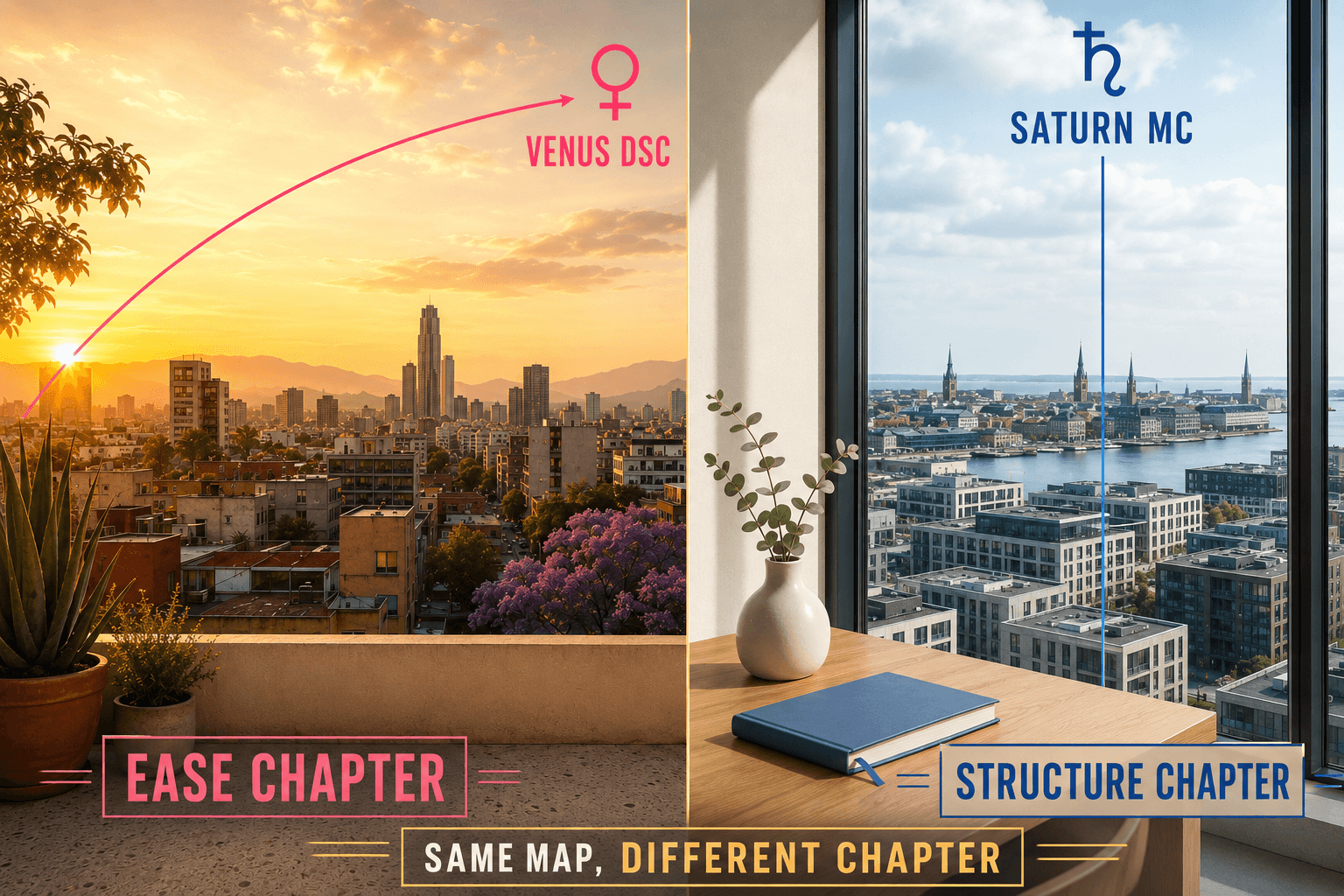
The second skipped variable is your current life chapter. Saturn lines tend to amplify discipline, structure, and long-term building. If you're at the start of a deliberate career-building decade, that's likely the support you need. If you're in a year of recovery from burnout, that's likely the last thing you need. The line didn't change. You did.
Astrocartography is mathematically reproducible, the system Jim Lewis built in the 1970s and trademarked as AstroCartoGraphy. The lines on the map are the same for every practitioner reading the same birth data. What changes is the interpretation, and the interpretation tends to require all three variables, not just one.
The "best" formula: planet x angle x chapter
Here's the shape of the idea before any examples. Think of choosing the best astrocartography line for yourself as a function of three inputs:
Planet is the theme. It tells you what energy tends to get amplified at that location. The 10 planet lines each carry a distinct register, and the rest of this article walks through them one by one.
Angle is the life domain. The same planet's energy lands differently depending on which of the four angles the line crosses. The Midheaven (MC) is the public, professional, vocational angle. The Imum Coeli (IC) is the private, foundational, family-and-home angle. The Ascendant (ASC) is the self, the body, how you carry yourself. The Descendant (DSC) is the relational mirror, partnerships, the close other.
Chapter is what's actually going on in your life right now. Career-building. Recovery. Family-forming. Starting over. Coming home. Each chapter has support it needs and support it doesn't need, and a line that's supportive in one chapter is often the wrong support in another.
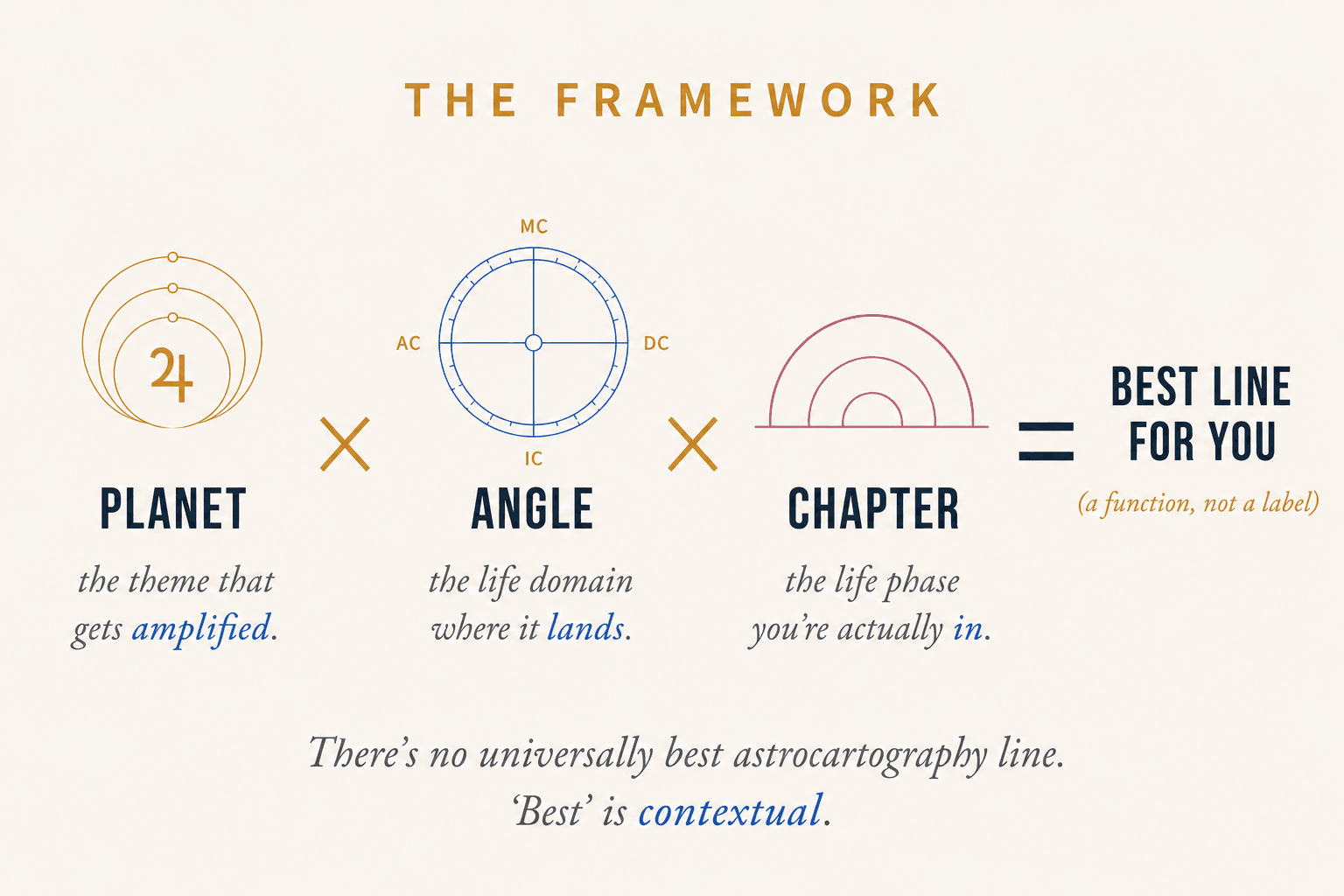
If any one of these inputs is missing, the answer to "which line is best" tends to be incomplete. The honest version is: best line for you = the planet whose theme matches what you're trying to amplify, on the angle that matches the life domain where you want it, in a chapter that can actually use it.
One worked example: a Saturn MC line tends to be the right line for someone in a deliberate career-building decade. The discipline, the structure, the long-arc foundation-laying. That same Saturn MC line tends to feel like grinding hardship for someone in a year of needed rest. The line didn't get worse. The chapter wasn't a match.
What each planet line tends to amplify
This is the directory of astrocartography lines explained: ten planet lines, what each tends to bring up, and the kind of chapter where the line tends to serve. None of this is prescriptive. It's a starting point you can match against your own situation. The mini-sections below are ordered Sun through Pluto in traditional astrological sequence, not in any order of preference.
The Sun line tends to amplify vitality, visibility, and the version of yourself that wants to be seen. Places along your Sun line often correspond to a chapter where you stop hiding, take up more room, or finally claim something publicly that you'd been keeping quiet. The Sun line is the line of being recognized as yourself, not the role you'd been performing.
Tends to serve: A chapter where visibility matters: launching the thing you'd been building privately, stepping into leadership, becoming the version of yourself you'd been deferring. Shadow: making the visibility the point instead of the work underneath it.
The Moon line tends to amplify emotional belonging, family, and the feeling of coming home to yourself. People on or near their Moon lines often describe a softer interior life, a deeper sense of being held by the place, and a quieter relationship with their own emotional needs. It's the line of feeling at home in a body and in a place.
Tends to serve: A chapter that needs rest, recovery, family-forming, or a soft landing after a hard period. Covered in depth in our upcoming Moon line article. Shadow: using the soft landing to avoid the harder external work that's also waiting.
The Mercury line tends to amplify communication, learning, writing, and the mental life. Places along your Mercury line often correspond to a chapter of clearer thinking, a creative writing window, a season of study, or a city where ideas seem to land more easily. Mercury is the line of the mind getting room to move.
Tends to serve: A chapter where intellectual work, study, or a communicative project is central. Writers, students, teachers, idea-heavy phases. Shadow: overthinking, scatter, staying in the head when the chapter actually needs something the body has to learn.
The Venus line tends to amplify ease, beauty, pleasure, softness, and connection. Places along your Venus line often correspond to a chapter where things move more gently, relationships soften, the senses come back online, or the body remembers how to enjoy itself. The Venus line is the line of life-as-it-could-be-easier. We go deep on the Venus line in its own article.
Tends to serve: A chapter where you've been overworked, hardened, or starved of softness, and a softer geography is the support you need. Shadow: mistaking ease for resolution, or settling into a Venus city when the chapter actually wanted growth.
The Mars line tends to amplify drive, ambition, energy, and the willingness to fight for something. Places along your Mars line often correspond to a chapter of new pursuit, a project taken on with real teeth, or a city where you find a level of motivation that surprises you. Mars is the line of getting things done, sometimes including the fights you've been avoiding.
Tends to serve: A chapter of building, starting, training, competing, or going after something you'd been circling. Covered in our upcoming Mars line article. Shadow: reactivity, conflict, or burning the fuel faster than you can replenish it.
The Jupiter line tends to amplify expansion, opportunity, generosity, and the experience of doors opening. Places along your Jupiter line often correspond to a chapter where things widen, networks grow, and the kind of luck that's actually preparation-meeting-opportunity starts showing up. Jupiter is the line of more room. We go deep on the Jupiter line in its own article.
Tends to serve: A chapter of growth, scaling, learning a bigger frame, or stepping into a season of opportunity. Shadow: over-extending, mistaking expansion for direction, or growing in a way that isn't actually serving.
The Saturn line tends to amplify structure, discipline, responsibility, and long-term foundation-building. Places along your Saturn line often correspond to a chapter of seriousness, mastery, or building something that's going to last. Saturn is the line of slow, deliberate work that compounds. We go deep on the Saturn line, including the "crucible not curse" reframe, in its own article.
Tends to serve: A deliberate career-building decade, a recovery chapter where structure is the medicine, or a mastery year. Shadow: grinding, isolation, or arriving in a Saturn chapter without the support to hold it.
The Uranus line tends to amplify disruption, innovation, freedom, and sudden change. Places along your Uranus line often correspond to a chapter that breaks a pattern, surfaces an unconventional path, or finally lets the version of you that doesn't fit the old shape come forward. Uranus is the line of the unexpected being welcome.
Tends to serve: A chapter where the old structure has to break for the new one to form. Reinventing a career, leaving a setup that no longer fits, or stepping into work that's genuinely original. Shadow: instability, reactivity, or change-as-escape from something that actually needed a smaller pivot.
The Neptune line tends to amplify imagination, creative work, spirituality, dissolution, and the porous edges of the self. Places along your Neptune line often correspond to a chapter of creative immersion, a spiritual deepening, or a season where the boundaries of who you are tend to soften. Neptune is the line of the dream getting more vivid.
Tends to serve: A creative chapter, a spiritual practice that needs depth, or an artist's residency phase of life. Shadow: fog, escapism, addiction, or losing the practical thread. Neptune cities tend to reward a strong existing structure (job, routine, support) and tend to dissolve a weak one.
The Pluto line tends to amplify transformation, depth, and the surfacing of what's been buried. Places along your Pluto line often correspond to a chapter where something already-ending finishes, a version of yourself you'd outgrown falls away, or a structure in your life that's been hollow finally names itself. Pluto is the line of completing what was already in motion. We go deep on the Pluto line in its own article.
Tends to serve: A chapter that's already ready for honest reckoning. Shadow: rebuild-as-escape, obsession, or arriving at a Pluto line in a chapter that wanted stability, not excavation.
How the 4 angles change the register
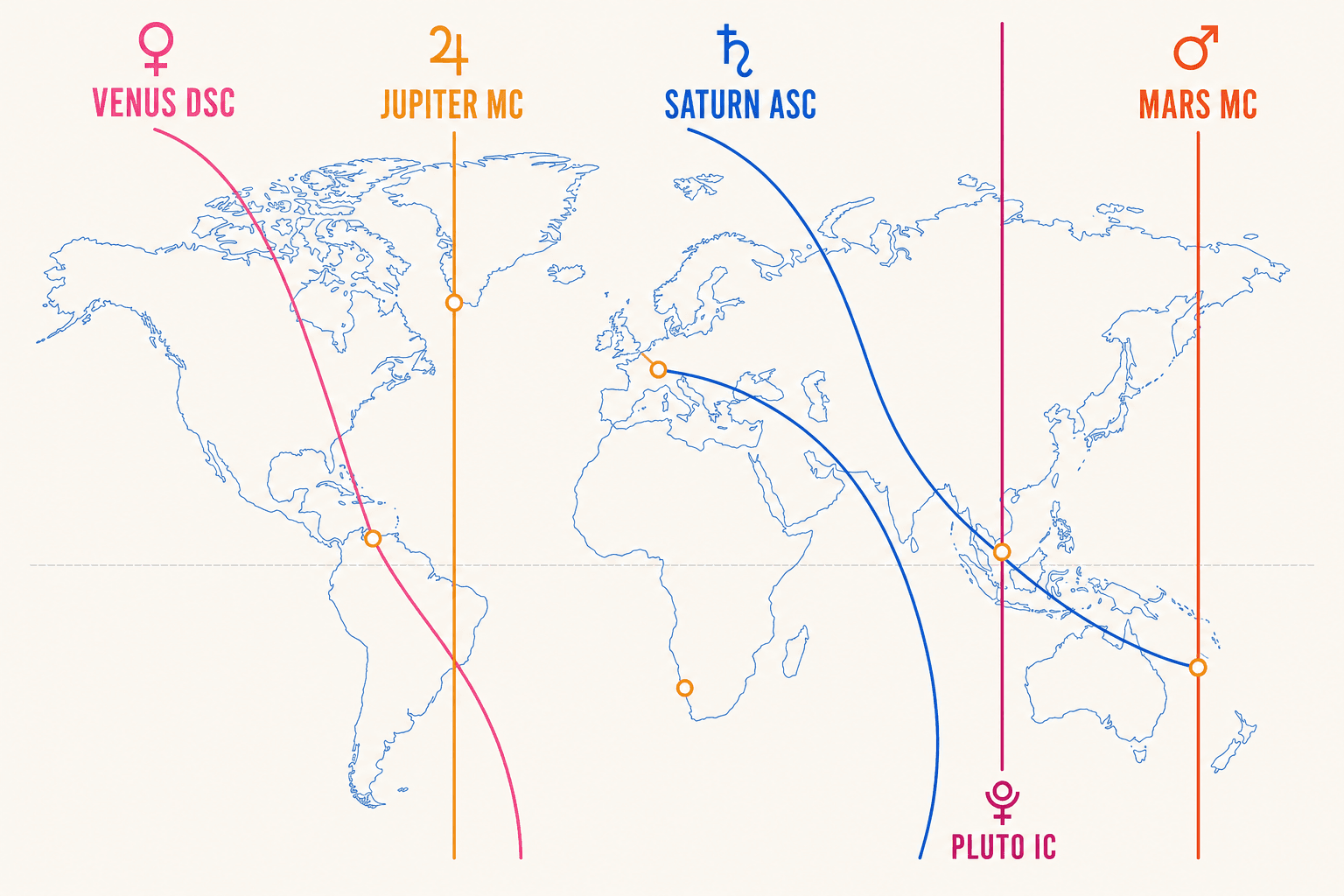
Same planet, different domain. The angle is the second variable in the formula, and it's the one most ranked listicles skip entirely. Here's what each angle tends to do to whatever planet lands on it.
MC line: the Midheaven (public life and career)
The MC is the highest point of the chart, the vocational and public-facing angle. A planet on your MC line tends to amplify its theme in your career, your professional identity, your reputation, and the version of you the world meets. Saturn MC reads as career structure. Jupiter MC reads as career expansion. Venus MC reads as career softness or working in a beauty-adjacent field.
IC line: the Imum Coeli (home, roots, private life)
The IC is the deepest point of the chart, the foundational angle. A planet on your IC line tends to amplify its theme in your home life, your family, your roots, and the parts of you most people never see. Moon IC reads as a deeply held home. Saturn IC reads as a structural rebuilding of the private foundation. Pluto IC reads as inherited family material surfacing for honest reckoning.
ASC line: the Ascendant (self, body, how you carry yourself)
The ASC is the rising point, the angle of self and presentation. A planet on your ASC line tends to amplify its theme in how you show up, how you carry yourself, and how others see you on first meeting. Mars ASC reads as visible drive. Venus ASC reads as a softer presence. Uranus ASC reads as visibly unconventional.
DSC line: the Descendant (partnerships, the close other)
The DSC is the setting point, the angle of close relationships. A planet on your DSC line tends to amplify its theme in your partnerships, your friendships, and the kind of people who arrive in your close circle. Venus DSC reads as relational softness and the partner-as-pleasure. Pluto DSC reads as the partner-as-mirror who refuses to look away. Saturn DSC reads as relationships that ask something of you and reward the commitment.
Matching the line to the chapter
Here's how to use the directory. Start with the chapter, not the line. What life phase are you actually in right now? The match runs from chapter to line, not the other way around. A few common patterns I tend to see in readings:
Career-building decade
Deliberate structure, long-arc foundation, discipline. Mars MC if it's specifically about ambition and starting with real teeth. Shadow: choosing it in a chapter that actually wanted rest.
Healing or coming home
Emotional belonging, the softer interior, the sense of being held. Venus IC is the gentler version of the same energy. Shadow: hiding in the softness when the chapter eventually needs you to come back out.
Reinventing your work
The unconventional path, the unexpected opening. Jupiter MC works when the reinvention is more about scaling than disruption. Shadow: disruption-for-its-own-sake.
Creative or spiritual deepening
Neptune IC for inner work, Neptune MC for creative-as-vocation. Shadow: fog without practical structure. This line tends to reward an existing routine.
Building a partnership chapter
Venus DSC for relational softness. Saturn DSC for serious partnership that asks for commitment. Pluto DSC for partnerships that restructure you. Match to what kind of partnership the chapter is looking for.
A chapter already ending
Pluto MC for a career chapter, IC for family or home, ASC for a version of yourself, DSC for a relationship. Shadow: forcing transformation in a chapter that needed stability.
Each of these mappings is a starting point. Your full chart matters. Your existing life setup matters. Whether a city is otherwise livable for your circumstances matters. The line is one input.
When "best-line shopping" becomes a trap
A reader once told me, after we'd been working through their map for half an hour, "I think I want to live on my Jupiter line because Jupiter is the lucky one." That sentence is the failure mode of the ranked listicle. They'd picked a label and were now trying to fit a city to it.
Best-line shopping has three common shapes. The first is over-identification with a single line, where you build a story around one planet (usually Venus or Jupiter, because they're the ones the internet calls "good") and stop reading anything else on your chart honestly. The second is chasing a "good" line into a city that doesn't otherwise fit your life. The job isn't there, the visa is hard, the support network is somewhere else, but the Venus line passes through and so the city becomes the plan. The third is treating astrocartography as the answer instead of one input among many.
The honest frame is simple: astrocartography belongs in the conversation with visa requirements, climate, finances, relationships, language, and your own lived experience of places you've been. Not above them. If you're new to that frame, our honest look at whether astrocartography is real walks through what the technique does and doesn't do.
The line is a description of a tendency, not a verdict. The chapter is yours to know. The city has to work in the rest of your life too. Hold all three and the directory above becomes useful instead of seductive.
If you want a practitioner to do the analytical mapping with you, our Find Cities reading takes your birth data, your current chapter, and the actual constraints of your life, and tells you honestly which cities on your map fit the brief you're really working with.
How to find your best lines on a free chart
Here's the practical part, because the directory only helps if you can actually see your own lines. Go to AstroSeek or Astro.com, enter your birth data, and pull up your astrocartography map. You'll see up to 40 lines, 10 planet lines on each of 4 angles. Most readers find the visual overwhelming the first time, which is normal.
Start by identifying the planet lines that run through regions you'd realistically consider, given the rest of your life. Then check which angle each one is on. A Saturn line through your candidate city is meaningful, but a Saturn MC line through it tells you more.
Pay attention to orb. The influence tends to be strongest right at the line and fades within about 4 to 5 degrees of longitude (roughly 400 to 550 km at the equator, less at higher latitudes). A city sitting right on a line will feel the effect more strongly than one 5 degrees away. Close enough is close enough.
If you want a quick reference for all the planet-line combinations while you explore, our free astrocartography cheatsheet covers every one.
Match what you find against the chapter you're actually in. If the line and the chapter line up, that city deserves a closer look. If they don't, the line is information, not a verdict.
With care, Victor