
✦ Start here: the quick read
Is astrocartography real? The short, honest version: yes, as a reproducible technique, and yes in the way that practitioner craft tends to be real, but no in the sense of clinical-trial proof. If you've landed here from a search, you're probably asking one of three things: is this technique made up, or is there actually something to it? Is it scientifically valid? And is it worth my time and money?
All three are fair questions. This article takes them seriously.
The question is really two questions
When someone asks "is astrocartography real?", they're usually stacking two different questions on top of each other.
The first is about the technique itself. Is astrocartography a reproducible method, or is it something a practitioner invents on the spot? That question has a clear answer. The second is about what the technique describes. Does a Venus line or a Saturn line actually correspond to something you'd notice in your life, or is it pattern-matching after the fact? That question is more interesting, and more honest.
The two questions deserve separate answers, and the rest of this article gives them to you plainly. You can read it as someone considering a reading, or as someone already halfway skeptical. Either works.
If you're completely new to the technique, what astrocartography is and how it works is the better starting point. If you already know the basics and want to see how to actually read your own map, how to read your astrocartography chart walks you through it. This article assumes you've at least seen the concept and are asking whether it holds up.
What astrocartography observably does
Astrocartography is the line-based mapping system Jim Lewis developed in the 1970s and trademarked as AstroCartoGraphy. It's not a vibe. It's a projection.
Here's what the technique actually does, mechanically:
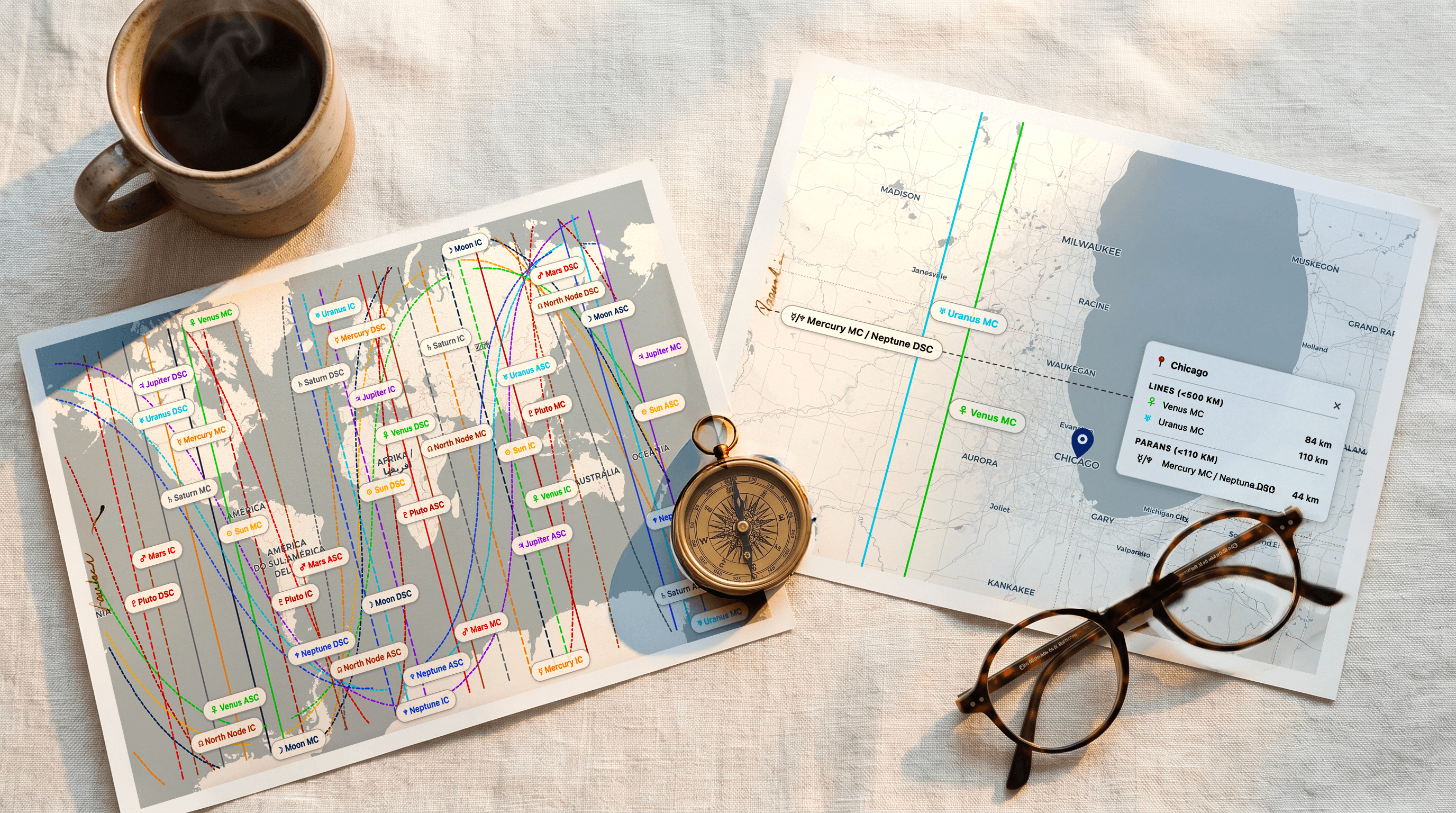
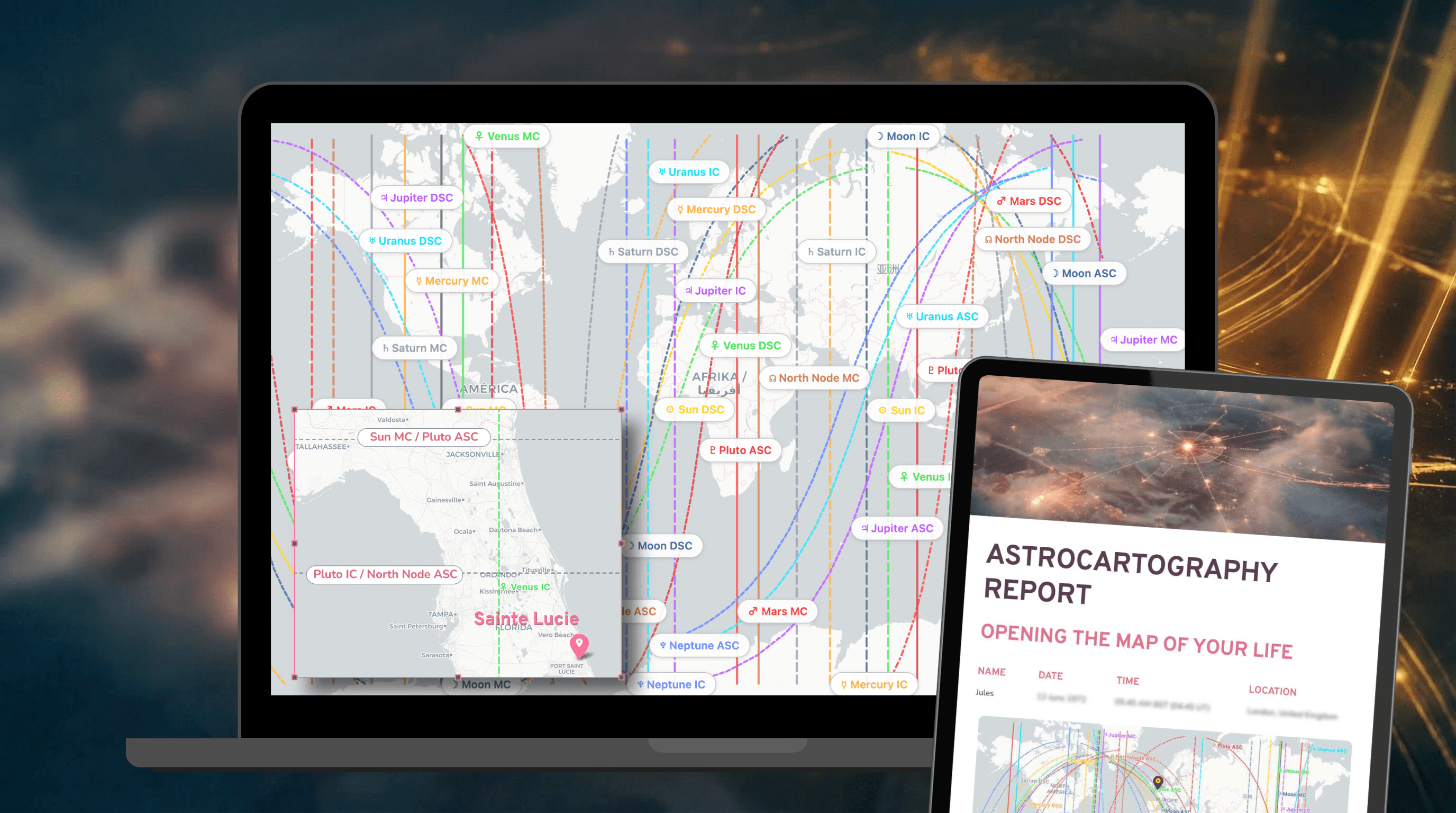
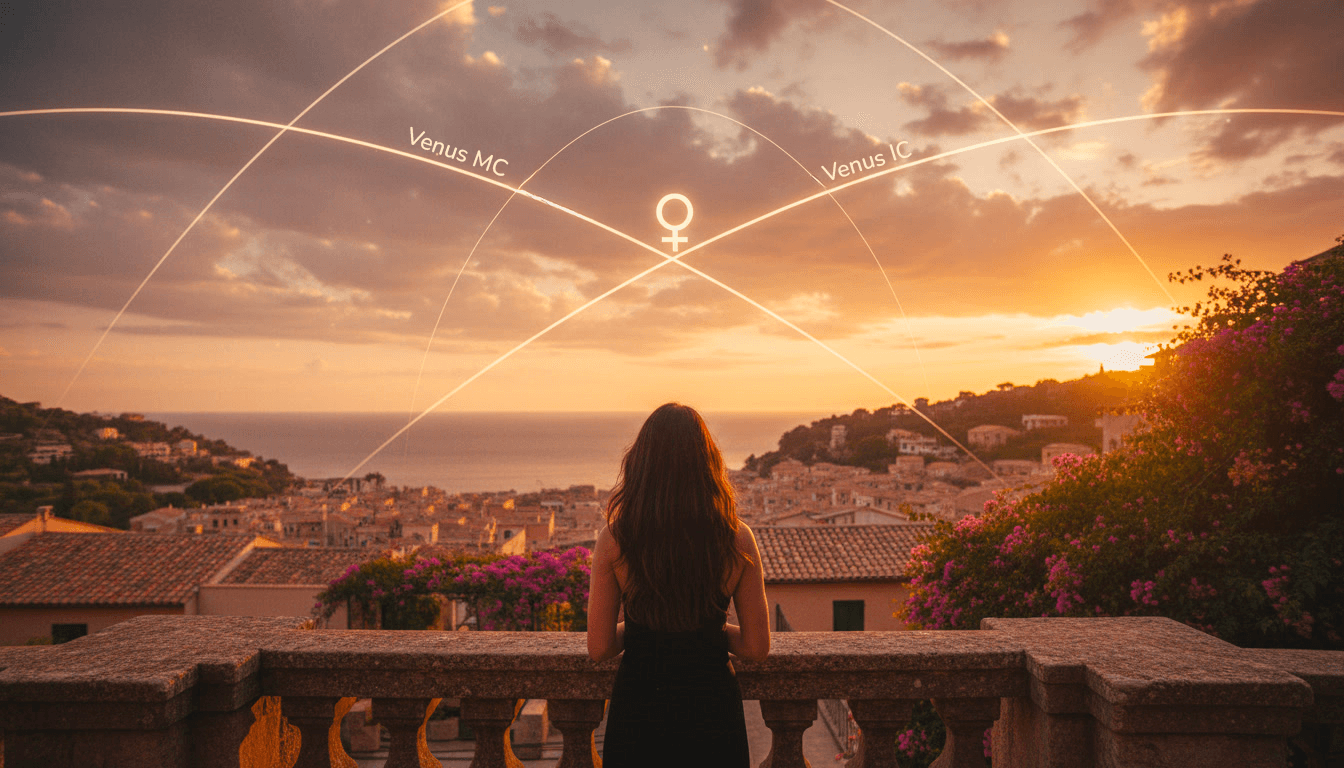
It takes your natal chart (the positions of the Sun, Moon, and planets at your exact birth moment) and projects each planet onto the globe as it relates to four angles: the Midheaven (MC), the Imum Coeli (IC), the Ascendant (ASC), and the Descendant (DSC). Each planet on each angle produces a line across the Earth. Ten planetary bodies times four angles gives you forty distinct lines on your personal map.
Those lines are the same for every practitioner working from the same birth data. If you hand your chart to three different astrocartographers, the lines on their maps will match to the degree. That's what "reproducible" means here. The math is the math.
This matters because it separates astrocartography from the kind of reading where the output depends on the practitioner's mood. The map itself is fixed. What varies is the interpretation, and good interpretation is grounded in a long tradition of practitioner observation about what each planet tends to activate. That tradition has its own kind of rigor, which we'll get to in a moment.
What it honestly doesn't do
Being honest about what astrocartography is means being equally honest about what it isn't.
It isn't predictive. A Venus line through Lisbon doesn't mean you'll fall in love there. It means the Venus themes in your chart (connection, pleasure, ease) tend to show up more actively in that geography. The difference matters. One is a promise; the other is a texture.
It isn't deterministic. Living on a Saturn line doesn't doom you to hardship, and living on a Jupiter line doesn't guarantee expansion. Your actual experience depends on the life chapter you're in, the choices you make, and dozens of factors the map knows nothing about.
It isn't scientifically validated in the clinical-trial sense. There are no peer-reviewed double-blind studies showing that people on their Venus lines report more love experiences than a control group. If that's the standard of evidence you need, astrocartography won't meet it, and nobody honest in this field will tell you it does.
It isn't a substitute for your own lived experience. If you've lived somewhere for five years and know how it feels in your body, that data is more trustworthy than any line on any map. Astrocartography belongs in conversation with your own experience, not above it.
Naming these limits is the price of being taken seriously.
The evidence base, named honestly
So what kind of evidence does astrocartography actually have behind it?
Two kinds, and they're different.
The first is lineage and craft. Jim Lewis didn't invent astrocartography from nothing. He built on astrological traditions that go back centuries, synthesized them with then-new computer-plotting techniques, and refined the method through decades of readings before his death in 1995. The field has continued through practitioners who've tested and refined interpretations across tens of thousands of readings. That's a body of knowledge built the way craft knowledge tends to get built: through observation, iteration, and what holds up across cases.
The second is practitioner evidence. In our own practice, we've now run over 500 readings. Patterns show up again and again. Clients identify their Venus line on a map before we tell them which one it is. People name the texture of their Saturn line city without prompting. A Mars line cluster tends to show up in the chart of someone who's been describing the exact themes it's known for. These things happen often enough, and specifically enough, that "coincidence" stops being a satisfying explanation.
This is real evidence. It's not the same kind of evidence you'd get from a controlled trial, and it doesn't pretend to be. But it's the kind of evidence you'd accept from a skilled therapist describing patterns across their clients, or from a doctor describing what they've seen in their practice. Dismissing practitioner pattern-recognition because it isn't lab science is a specific kind of category error.
The 4-step readiness check
After working with hundreds of clients, I've come to believe the most useful question isn't "is astrocartography real?" It's "am I ready to use this technique well?"
These four questions help you decide.
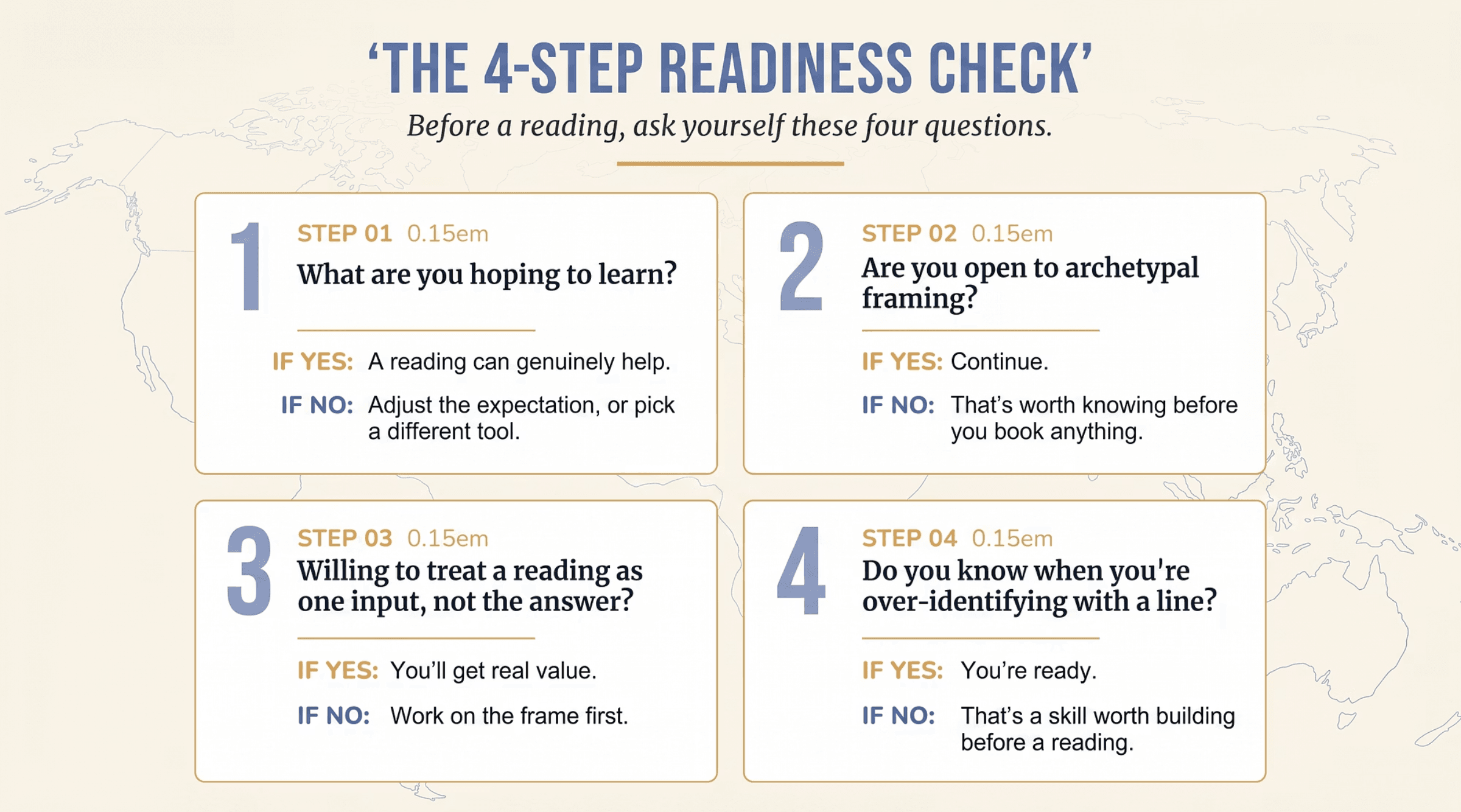
Step 01. What are you hoping to learn?
If you want direction, an archetypal framework, or a useful second opinion on a city you're already considering, astrocartography tends to deliver. If you want a yes-or-no prediction about whether moving somewhere will make you happy, it won't.
If yes: a reading can genuinely help. If no: adjust the expectation, or pick a different tool.
Step 02. Are you open to archetypal framing?
Astrocartography speaks in themes. A Jupiter line doesn't say "you'll get a promotion"; it says "this place tends to amplify Jupiter themes for you: expansion, opportunity, optimism." A Venus line doesn't promise love; it describes texture. If that kind of framing feels meaningful to you, you're in the right place. If it feels too abstract to act on, the tool probably won't land.
If yes: continue. If no: that's worth knowing before you book anything.
Step 03. Are you willing to treat a reading as one input, not the answer?
The readings that go best are the ones where the client is weighing astrocartography alongside finances, visa logistics, relationships, climate, and their own gut feeling. If you want a fuller walkthrough of that approach, how to use astrocartography to choose where to live lays out the framework. Readings that go badly tend to be the ones where someone wants the map to make a major life decision for them. The map can't do that, and you wouldn't actually want it to.
If yes: you'll get real value. If no: work on the frame first.
Step 04. Do you know how to notice when you're over-identifying with a line?
Confirmation bias is the single biggest pitfall in any symbolic system. If you hear "Saturn line" and start filtering every rough moment through that lens, you've stopped using the tool and started projecting. The readiest clients are the ones who can hold an interpretation lightly and stay curious about whether it actually fits.
If yes: you're ready. If no: that's a skill worth building before, not after, a reading.
The better question
"Is astrocartography real?" collapses a lot of nuance into a single yes/no. Once you've separated the two questions inside it, and named the evidence honestly, the more useful question is almost always "is it useful for me, right now?"
For some people, right now, the answer is yes. A reading gives them a frame that sharpens a decision they were already circling. For other people, right now, the answer is no. Maybe the archetypal framing isn't their thing. Maybe they're in a life chapter where they need data of a different kind. Both answers are fine. The honest version of this technique respects both.
If you want a hands-on tour of what the technique can actually show you before deciding whether to book, our free astrocartography cheatsheet walks you through how to read the basic lines on your own map. And if the readiness check above landed well and you're curious what a careful reading of your own chart would actually say, our Compare Cities reading walks you through two or three specific cities side by side, with the same honest framing this article takes.
With warmth, Jules