✦ Start here: the quick read
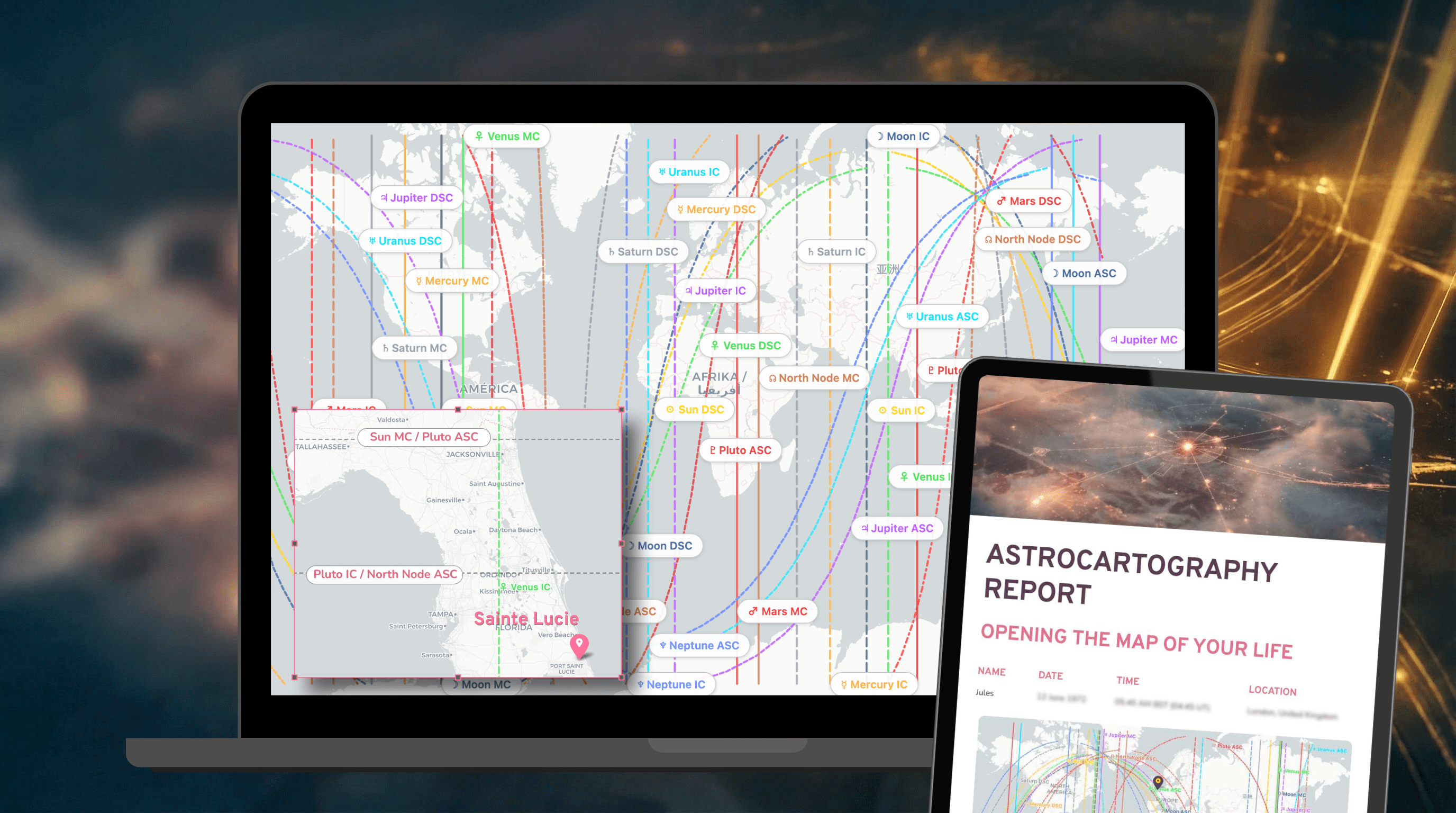
If you've ever pulled up your astrocartography chart and seen forty lines crossing the globe with letters like MC, IC, AC, and DC stuck onto them, this is the article that explains the four astrocartography angles and why they matter more than the planet line itself.
Here's the claim, up front: read your angles before you read your planets. The angle a line crosses tells you the life domain it tends to touch (career, home, self, or relationships). The planet only tells you the flavor. Most online astrocartography content gets this backward, and that's why so many readers end up over-identified with one planet line and confused about why a "good" Venus line in one city feels like nothing while a "scary" Saturn line in another feels like home.
If you're new to all this, what astrocartography is and how it works is the foundation, and how to read your astrocartography chart walks you through the practical map. This article zooms in on the four angles specifically: what each one governs, what each planet tends to do when it lands there, and the reading order that actually makes your map make sense.
The four angles, briefly
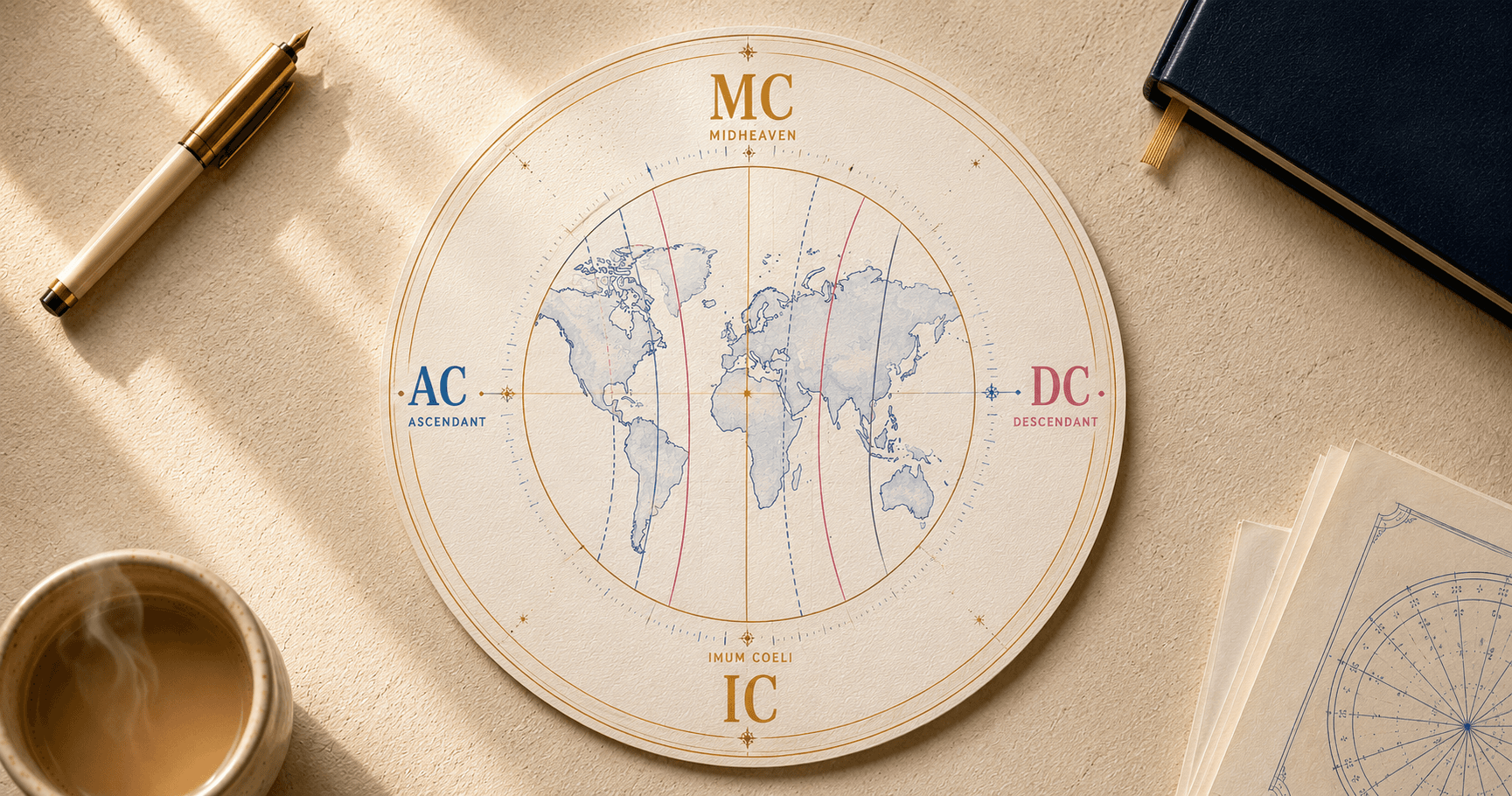
Astrocartography projects your natal chart onto the surface of the Earth. For every planet in your chart, there are four lines: one for the planet's position at each of the four chart angles. The angles are the four chart points that orient your natal chart in space, and astrologer Jim Lewis (who developed the modern astrocartography system, trademarked as Astro*Carto*Graphy, in the 1970s) projected them across the globe as continuous lines.
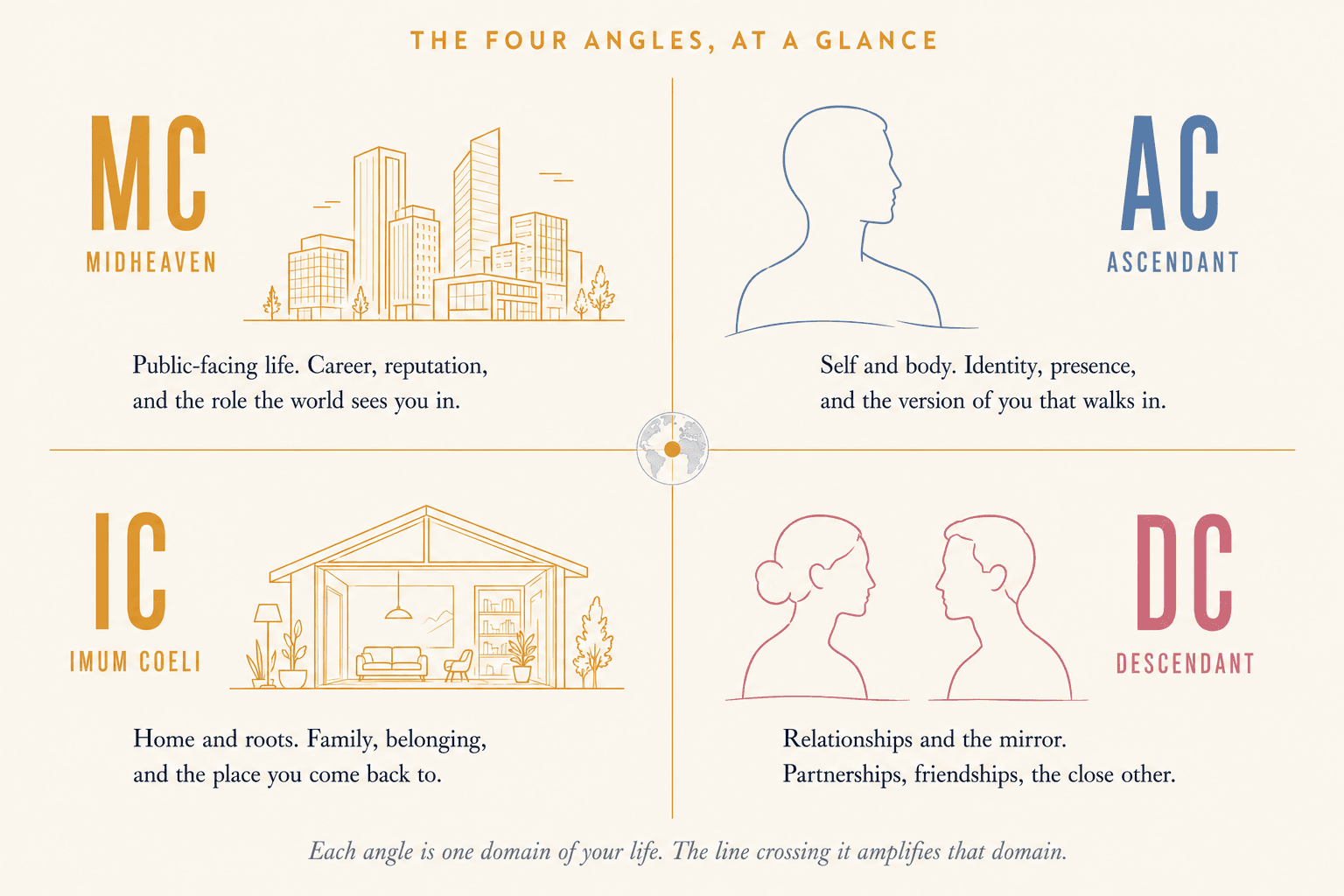
Your public life and career direction. The MC marks where a planet was at its highest point. Locations near an MC line tend to bring that planet's themes into your career and sense of purpose.
Your inner world and emotional foundation. The IC marks where a planet was at its deepest point below the horizon. Locations near an IC line tend to bring that planet's themes into your home life and sense of belonging.
Your identity and self-expression. The ASC marks where a planet was rising on the eastern horizon. Locations near an ASC line tend to amplify that planet's influence on your personality and how others perceive you.
Your relationships and partnerships. The DSC marks where a planet was setting on the western horizon. Locations near a DSC line tend to bring that planet's themes into your partnerships and significant relationships.
Same planet at different angles tends to feel meaningfully different. Below, each angle gets a short walk-through of what tends to show up when each of the ten major planets crosses it.
The MC line: your public-facing axis
The MC, or Midheaven, is the highest point your chart reaches as the Earth rotates. It's the angle of visibility: career, public reputation, the role you carry in the world, the way you're known. A planet line crossing the MC in a given place tends to amplify that planet's theme through the most visible part of your life.
☉Sun MC tends to bring a chapter where what you're known for becomes more aligned with who you actually are. Vocation surfaces.
☽Moon MC tends to bring a career colored by emotional register: caring work, public-facing nurturance, or visibility tied to mood and rhythm.
☿Mercury MC tends to bring work centered on communication, writing, teaching, or being the person who explains things publicly.
♀Venus MC tends to bring public-facing softness. Aesthetic work, relationship-centered roles, or a likability that opens professional doors. (See the Venus line for more on Venus across all four angles.)
♂Mars MC tends to bring drive and ambition into visible life. The chapter where you push hard for what you've been wanting and the world sees you push.
♃Jupiter MC tends to bring expansion in career and reputation. Opportunities widen. The role grows. (See the Jupiter line.)
♄Saturn MC tends to bring structure to public life. The career that's built slowly and earned. Not glamorous. Real. (See the Saturn line.)
♅Uranus MC tends to bring sudden public shifts or unconventional career paths. The role that doesn't fit an existing template.
♆Neptune MC tends to bring creative, artistic, or compassionate vocations, but can blur how clearly you're seen at work.
♇Pluto MC tends to restructure career identity from the foundation up. The job that ends because it has to. (See the Pluto line.)
The IC line: your home-and-roots axis
The IC, or Imum Coeli (Latin for "bottom of the sky"), is the lowest point your chart reaches. It's the angle of privacy: home, family, where you come from, what you root in, what you build a base on. A planet line crossing the IC tends to land in your private life rather than your public one. This is the angle a lot of readers underestimate, because it's quiet. Quiet doesn't mean unimportant.
☉Sun IC tends to bring a chapter where your sense of self organizes around home, family, or where you come from.
☽Moon IC tends to bring emotional belonging. The home you actually feel held in. The place that quiets your nervous system.
☿Mercury IC tends to bring a home life centered on conversation, learning, or work that happens at home.
♀Venus IC tends to bring softness, beauty, and ease to the private side of life. The home you genuinely love coming back to.
♂Mars IC tends to bring drive into the private domain, sometimes as productive energy, sometimes as friction at home.
♃Jupiter IC tends to bring expansion and abundance into home and family life. The roots that widen.
♄Saturn IC tends to bring structure to the private life. The home you build with care, or the family patterns that get worked through with discipline.
♅Uranus IC tends to bring disruption to the home base. Frequent moves, unconventional living arrangements, or a sudden break with where you came from.
♆Neptune IC tends to bring an idealized or dreamlike home. Spiritually rich, sometimes hard to keep grounded.
♇Pluto IC tends to rebuild private life from the foundation up. Family patterns surface and get reckoned with.
The AC line: your self-and-body axis
The AC, or Ascendant (also written ASC), is the point where the eastern horizon meets the ecliptic at the moment of your birth. It's the angle of self: how you show up, your body, your identity in a given place, the version of you that walks into the room. A planet line crossing the AC tends to land in your sense of self and how others meet you when they meet you.
☉Sun AC tends to bring a chapter where you become more visibly yourself. Identity solidifies.
☽Moon AC tends to bring emotional visibility. You feel more, and other people register that you feel more.
☿Mercury AC tends to bring you forward as the communicator, the questioner, the person whose voice gets heard.
♀Venus AC tends to bring softness and likability into how you show up. People tend to find you easy to be around.
♂Mars AC tends to bring assertion and physicality forward. You move faster. You take up more room. Your body shows up.
♃Jupiter AC tends to bring expansion into how you're seen. Bigger presence, more optimism, more confidence.
♄Saturn AC tends to bring weight and seriousness to how you carry yourself. You age into yourself here.
♅Uranus AC tends to bring sudden identity shifts and an unconventional way of showing up. You don't quite fit the local pattern.
♆Neptune AC tends to bring a softer, more porous sense of self. Boundaries get blurry. Imagination expands.
♇Pluto AC tends to shift how you're perceived in a way other people register before you do. The version that walks out isn't the one that walked in.
The DC line: your relationship-and-mirror axis
The DC, or Descendant (also written DSC), sits directly opposite the AC and represents the angle of relationship: what and who you tend to meet, the partnerships that find you, the mirror life holds up to you. A planet line crossing the DC tends to land in your relational field. Not just romantic. All the relationships that matter.
☉Sun DC tends to bring partnerships that help you become more yourself. The other people who reflect your identity back.
☽Moon DC tends to bring emotionally resonant relationships. The friends who feel like home. The partner who can hold what you carry.
☿Mercury DC tends to bring relationships centered on conversation, ideas, and shared mental wavelength.
♀Venus DC tends to bring relational ease. Romance, harmony, friendship that flows. The connection that doesn't feel like work.
♂Mars DC tends to bring relationships with energy and friction. Strong attraction, sometimes strong conflict, often both.
♃Jupiter DC tends to bring relationships that expand you. Generous partners, mentors, friends who widen your world.
♄Saturn DC tends to bring serious, committed relationships. Slow-building, durable, sometimes weighty.
♅Uranus DC tends to bring unconventional or unexpected connections. The relationship that doesn't fit any template you had.
♆Neptune DC tends to bring dreamy, idealized, or spiritually meaningful relationships, with a tendency to blur who's actually there.
♇Pluto DC tends to bring partnerships that restructure you to the bone. Intimate in a way that asks something of you.
Reading order in practice: angles first, then planets
Here's the methodology I use in readings, and the one I'd hand any new reader before anything else.
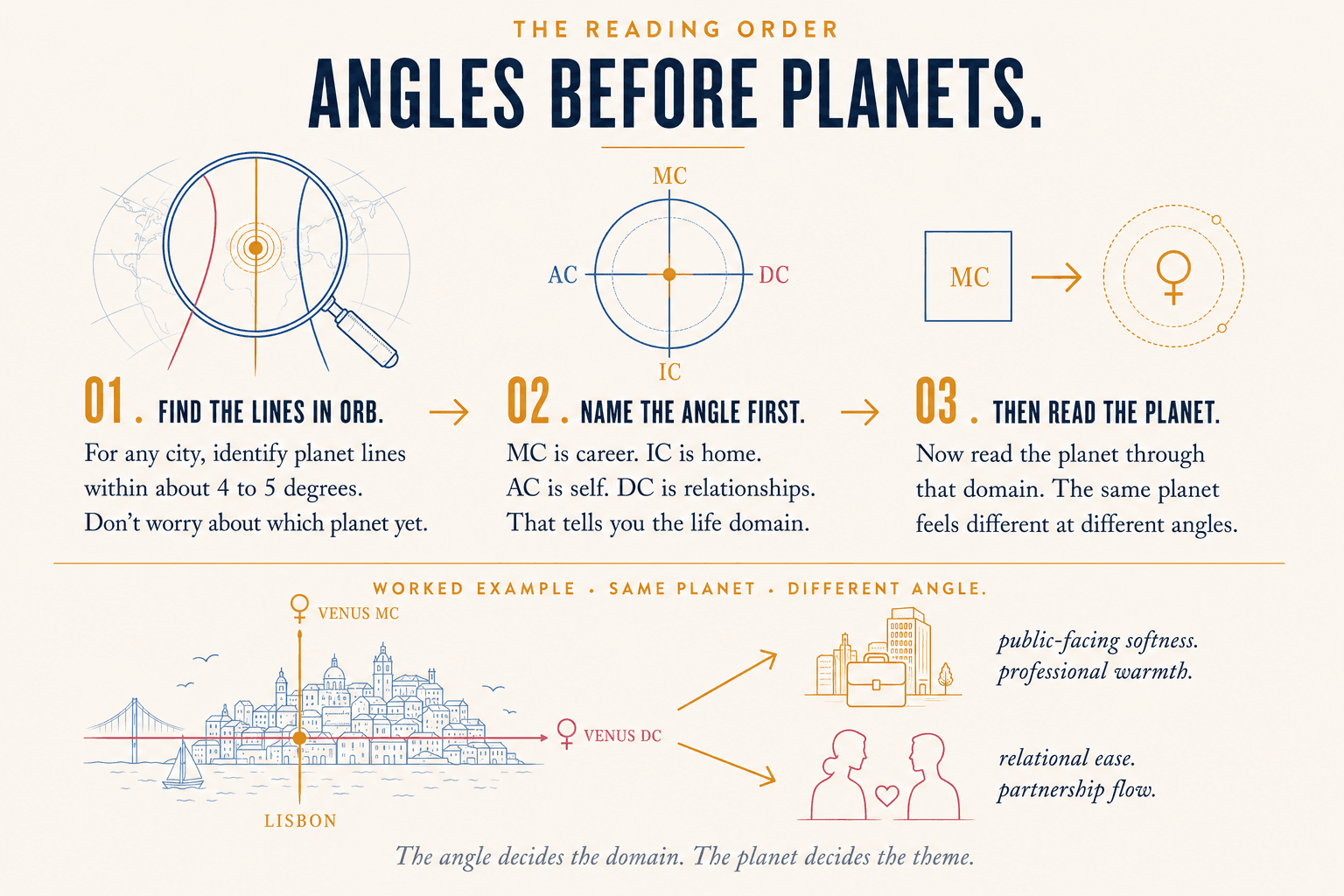
Step one. For any city you're looking at, identify which of your planet lines fall within orb (about 4 to 5 degrees on either side). Don't worry about which planet yet.
Step two. For each line, name the angle first. Is this an MC line? An IC? An AC? A DC? That tells you which life domain the line is going to land in. A line near Lisbon might be a Venus MC (public-facing softness, professional warmth) or a Venus DC (relational ease, romantic flow). They're both Venus. They're not the same experience.
Step three. Then read the planet through that domain. Now you can ask the real question: "Is this the kind of energy I want amplified in this part of my life, in the chapter I'm actually in?"
Honestly, here's what I see in readings: clients who learn to read angles first describe their map decisions as obvious in hindsight. Clients who chase planets first tend to over-identify with one line and pick a city that doesn't otherwise fit their life because a "good" planet line passes through it. Reading the angle first is the single highest-leverage habit you can build with your map, and it's the foundation of how to use astrocartography to choose where to live when you're evaluating actual cities.
The shadow side: when angle-blindness misleads
The common failure mode in astrocartography reading isn't picking the wrong planet. It's reading the planet without naming the angle.
A reader hears "you have a Venus line near Lisbon" and pictures romance. The actual line might be Venus DC, which tends to bring relational ease, or Venus MC, which tends to bring public-facing professional softness. Different experience. Different chapter served. Same planet.
There's a broader version of this in the honest look at whether astrocartography is real, but the practical takeaway is: angle-blindness is the single most common reason a "good" line disappoints, and naming the angle first usually catches it.
How to find your angles on a free chart
You don't need a paid tool to read your angles. Open AstroSeek or Astro.com, enter your birth data, and pull up your astrocartography map. Each planet's four lines are labeled with the angle abbreviation (MC, IC, AC or ASC, DC or DSC). The vertical lines on the map are the MC and IC lines for each planet. The curving lines that arc across the globe are the AC and DC lines.
Birth time matters here, more than for anything else in your chart. The angles shift roughly one degree every four minutes, so if your birth time is off by an hour, your angle lines can be off by 15 degrees of longitude. That's the difference between an MC line crossing Lisbon and an MC line crossing Madrid. If you're unsure of your birth time, the angle interpretations on your map are best treated as approximate.
Pay attention to orb. The influence tends to be strongest within about 4 to 5 degrees of longitude from the line. A city sitting right on a line will feel it more clearly than one 8 degrees away.
If you want a quick reference for all the angle and planet combinations while you read, our free astrocartography cheatsheet covers every one.
If you want a per-city read that respects which angle each line crosses, that's what our Compare Cities reading is built for.
The takeaway is simple. The angle decides the life domain. The planet decides the theme. Read the angle first, and the rest of your map starts making sense.
With warmth, Jules